Article Plan: Language Development Activities for 3-5 Year Olds
This article outlines a plan for fostering language skills in young children. It incorporates play-based learning, utilizing resources like downloadable PDFs, and focuses on both receptive and expressive language growth.
The period between three and five years represents a phenomenal leap in a child’s language abilities. This stage is characterized by a rapid expansion of vocabulary, increasingly complex sentence structures, and a growing capacity for understanding and expressing thoughts and feelings. Effective communication is foundational for social-emotional development, cognitive growth, and future academic success.
Early language skills aren’t solely about what children say, but how they communicate – their ability to listen, understand, and respond appropriately. Parents and educators play a crucial role in nurturing this development through intentional interactions and a language-rich environment. Resources, including readily available language development PDFs, offer structured activities and guidance.
These PDFs often contain age-appropriate exercises designed to stimulate both receptive (understanding) and expressive (speaking) language. They can provide ideas for storytelling, games, and activities that promote vocabulary acquisition and grammatical understanding. Understanding typical language milestones during this period is key to identifying potential areas for support and intervention. A proactive approach, utilizing available resources, can significantly impact a child’s linguistic journey, setting the stage for lifelong learning and effective communication.
II. Key Milestones in Language Development
Between ages three and five, children demonstrate remarkable progress in their linguistic abilities. Typically, three-year-olds use sentences of three to five words, ask “why” questions, and can follow simple two-step instructions. Their vocabulary expands rapidly, reaching around 300-. By four years old, they construct more complex sentences, tell stories (though often disorganized), and understand concepts like time (yesterday, today).
Five-year-olds generally speak in grammatically correct sentences, use a vocabulary of 1500-2000+ words, and can retell events in a logical sequence. They demonstrate an understanding of prepositions (on, under, beside) and engage in more sophisticated conversations. Language development PDFs often outline these milestones, providing a helpful benchmark for parents and educators.
It’s important to remember that these are averages; individual children develop at their own pace. However, significant delays in reaching these milestones may warrant further evaluation. These PDFs also frequently include activities tailored to specific developmental stages, helping to support children in reaching their full linguistic potential. Monitoring progress against these key milestones, alongside utilizing targeted resources, is crucial for early identification and support.
III. Receptive Language Skills (Understanding)
Receptive language, the ability to understand what is being said, forms the foundation for expressive language. For 3-5 year olds, this involves comprehending increasingly complex instructions, following multi-step directions, and understanding abstract concepts. A key milestone is grasping the meaning of prepositions – “put the toy on the table” – and understanding time-related words like “before” and “after.”
Activities to bolster receptive language include reading aloud, asking questions about stories ( “Who was the main character?”), and playing games that require following directions. Many language development PDFs emphasize the importance of simplifying language initially and gradually increasing complexity.

Observing a child’s response to questions and instructions provides valuable insight into their understanding. If a child consistently struggles to follow simple commands, it may indicate a need for focused support. Resources available in PDF format often provide specific exercises designed to target receptive language deficits, such as matching games and picture identification tasks. Consistent engagement with these activities can significantly enhance a child’s ability to comprehend and process information.
IV. Expressive Language Skills (Speaking)
Expressive language refers to a child’s ability to communicate thoughts, ideas, and feelings through spoken words. Between ages 3 and 5, children typically experience a rapid expansion in vocabulary and sentence structure. They move from using simple two-word phrases to constructing more complex sentences with correct grammar, though errors are still common and a natural part of development.
Encouraging expressive language involves providing ample opportunities for conversation, asking open-ended questions ( “Tell me about your day”), and expanding on a child’s utterances. For example, if a child says “Dog bark,” you can respond with “Yes, the dog is barking loudly!” Many language development PDFs suggest modeling correct grammar and pronunciation without directly correcting the child.
Activities like storytelling, role-playing, and describing pictures can stimulate expressive language. Printable worksheets and games found in PDF resources often focus on specific skills, such as naming objects, describing actions, and formulating questions; Consistent encouragement and a supportive environment are crucial for fostering a child’s confidence in expressing themselves verbally.
V. The Importance of Play-Based Learning
Play is not merely recreation for 3-5 year olds; it’s the cornerstone of language development. Through play, children naturally experiment with language, practice social interaction, and build crucial cognitive skills. Play-based learning provides a relaxed and engaging context where children feel comfortable taking risks and expressing themselves.
Many language development PDFs emphasize incorporating language-rich activities within play. This means narrating play scenarios (“You’re building a tall tower!”), asking questions (“What color is the block?”), and introducing new vocabulary related to the play theme. Dramatic play, such as playing house or doctor, is particularly effective for fostering expressive language.
Structured games, while beneficial, should complement, not replace, free play. PDF resources often offer printable game cards and activity suggestions, but the key is to allow children to lead and direct their play whenever possible. This fosters creativity and intrinsic motivation, maximizing language learning opportunities. A playful atmosphere reduces anxiety and encourages children to communicate more freely.
VI. Creating a Language-Rich Environment at Home
A language-rich home environment is crucial for supporting a child’s language development between the ages of 3 and 5. This doesn’t require expensive toys or elaborate setups; it’s about intentionally incorporating language into everyday routines.
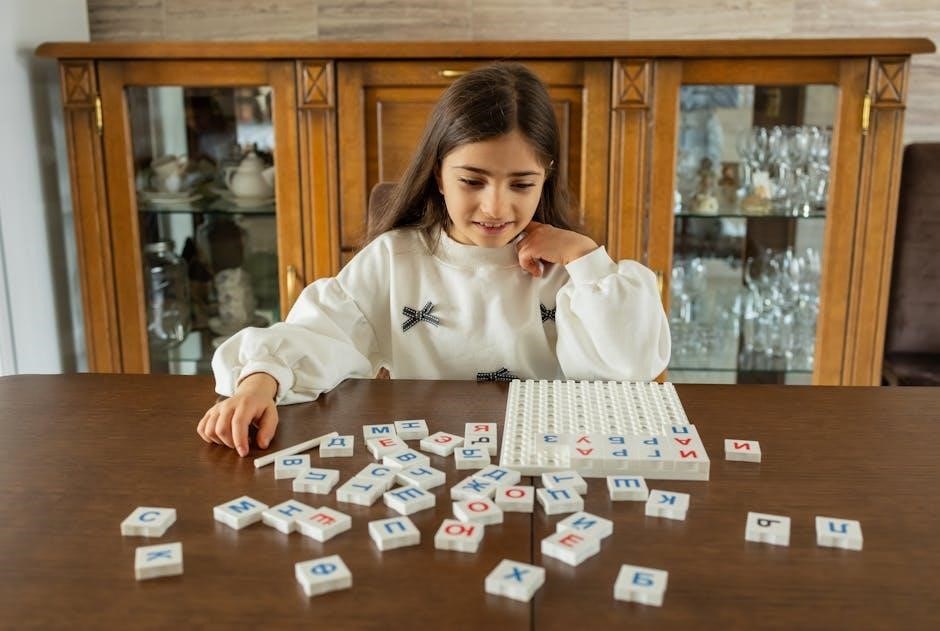
Many downloadable PDFs highlight the importance of consistent verbal interaction. Talk to your child frequently, describing what you’re doing, what they’re doing, and what you see around you. Expand on their utterances – if they say “Dog!”, you can respond with “Yes, that’s a big, brown dog!” Reading aloud daily is paramount, exposing children to new vocabulary and sentence structures.
Label objects around the house to reinforce vocabulary. Create a “reading nook” with accessible books. Limit screen time and prioritize face-to-face interactions. PDF resources often provide checklists for creating a language-stimulating home, suggesting simple changes like displaying artwork and encouraging storytelling. Remember, a responsive and engaged caregiver is the most valuable element of a language-rich environment.
VII. Specific Activities to Boost Language Skills
Numerous activities can actively boost language skills in 3-5 year olds, many of which are detailed in readily available PDFs. These activities should be playful and engaging, capitalizing on a child’s natural curiosity.
Storytelling and reading are foundational. Interactive reading – asking questions about the story, predicting what will happen next – enhances comprehension. Creating your own stories, even simple ones, encourages expressive language. Games like “I Spy” build vocabulary and descriptive skills, while rhyming games foster phonological awareness.

Arts and crafts provide opportunities for labeling and describing creations. Ask “What color is this?” or “Tell me about your picture.” Action songs and following directions improve receptive language. Many PDFs offer printable worksheets and activity guides focusing on these areas. Remember to adapt activities to your child’s individual interests and skill level, ensuring a positive and encouraging experience. Consistency and repetition are key to success.
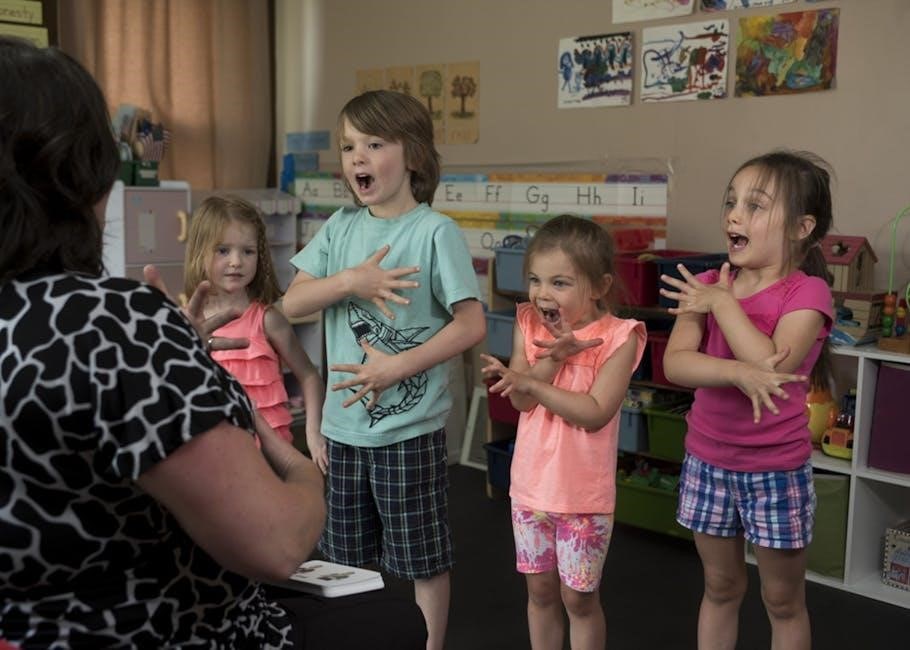
VIII. Storytelling and Reading Activities
Storytelling and reading are cornerstones of language development, with numerous resources available in PDF format to guide parents and educators. These activities build vocabulary, comprehension, and a love of language.
Begin with simple picture books, gradually increasing complexity. Encourage children to retell stories in their own words, fostering narrative skills. Act out scenes from books, using props and voices to enhance engagement. Downloadable PDFs often include story prompts and character cards to spark imagination.
Reading aloud exposes children to new words and sentence structures. Ask open-ended questions like “What do you think will happen next?” or “How does the character feel?” Creating your own stories, even collaboratively with your child, is incredibly beneficial. Focus on themes relevant to their lives, making the experience more meaningful. Many PDFs offer printable story templates and writing prompts to facilitate this process.
IX. Interactive Reading Techniques
Moving beyond simply reading words on a page, interactive reading techniques actively engage children and maximize language learning. Numerous PDFs offer guidance and printable resources to support these methods.
Utilize “pop-up” questions during reading – pausing to ask about characters’ feelings, predict outcomes, or connect the story to personal experiences. Encourage children to point to pictures and label objects, reinforcing vocabulary. Sound effects and varied voices add excitement and aid comprehension.
Implement “think-alouds,” where you verbalize your own thought process while reading, modeling comprehension strategies. Ask “what if” questions to stimulate critical thinking. Many downloadable PDFs provide pre-written interactive questions tailored to specific books. Repetitive reading of favorite books allows children to anticipate words and phrases, building confidence and fluency. Focus on making reading a playful, shared experience, rather than a task.
X. Creating Your Own Stories
Empowering children to become storytellers themselves is a powerful language development activity. It fosters creativity, narrative skills, and expressive language. Several PDFs offer story starters and prompts to inspire young authors.
Begin with collaborative storytelling – you start a story, then the child adds a sentence, and so on. Use picture prompts; show a picture and ask, “What’s happening here? Who are these characters?” Encourage children to dictate their stories to you, which you can then write down.
Simple storyboards with blank panels can help children visualize and sequence events. Focus on the elements of a story: characters, setting, problem, and solution. Printable templates available in language development PDFs can guide this process. Don’t worry about perfect grammar or spelling; the focus is on expressing ideas. Celebrate their imagination and encourage them to share their creations with others. This builds confidence and a love of language.
XI. Games for Language Development
Games are an incredibly effective and engaging way to boost language skills in 3-5 year olds. They provide a playful context for practicing vocabulary, grammar, and communication. Many downloadable PDFs offer printable game boards and activity cards specifically designed for this age group.
Focus on games that encourage interaction and turn-taking. Simple board games requiring children to name objects or follow directions are excellent. Card games like “Go Fish” can be adapted to focus on specific sounds or categories.
Digital games, when used appropriately, can also be beneficial. Look for apps and online games that emphasize language skills. Remember to balance screen time with other activities. Printable game instructions and variations found in language development PDFs can add variety and challenge. The key is to make learning fun and interactive, fostering a positive association with language.
XII. “I Spy” and Object Identification
“I Spy” is a classic game that powerfully supports receptive and expressive language development. It encourages children to listen carefully for descriptive clues and then identify the hidden object. Variations can target specific skills, like color recognition, shape identification, or initial sounds.
Begin with simple clues like “I spy something blue” and gradually increase complexity. Encourage children to ask clarifying questions: “Is it big?” “Is it soft?” Extend the game by having the child give the clues, practicing their descriptive language.
Many language development PDFs include printable “I Spy” sheets with themed images, offering a structured approach. Object identification activities, like naming pictures or pointing to labeled items, build vocabulary. Combine these with real-world “I Spy” games during outings or at home. This reinforces learning in a practical context, making it more meaningful and memorable for young learners. Remember to adapt the difficulty to the child’s individual level.
XIII. Rhyming Games and Word Play
Rhyming games are incredibly beneficial for phonological awareness, a crucial pre-reading skill. They help children recognize and manipulate the sounds within words, laying the foundation for decoding and spelling. Start with simple rhyming pairs like “cat” and “hat,” then progress to more challenging combinations.
Activities can include rhyming matching games, where children pair rhyming pictures or words. “Rhyme Time” involves saying a word and asking the child to generate a rhyming word. Word play, such as alliteration (e.g., “silly snakes”) and silly sentences, expands vocabulary and encourages creative language use.
Numerous language development PDFs offer printable rhyming cards and game ideas. Singing rhyming songs and reading rhyming books are also effective. Focus on making it fun and playful! Don’t correct errors immediately; instead, offer gentle prompts and encouragement. The goal is to build confidence and a love for language, fostering a positive attitude towards learning.
XIV. Arts and Crafts for Language Stimulation
Arts and crafts provide a multi-sensory experience that powerfully stimulates language development. The process of creating allows children to express themselves and communicate their ideas, while also building vocabulary related to colors, shapes, textures, and actions.
Encourage children to describe their artwork as they create it – “I’m painting a blue sky,” or “I’m gluing on sparkly stars.” Ask open-ended questions like, “Tell me about your picture,” or “What are you making?” Labeling and categorizing objects used in the craft (e.g., “This is glue, it’s sticky!”) reinforces word recognition.
Many language development PDFs include craft templates with accompanying language prompts. Simple activities like drawing, painting, collage, and playdough modeling are excellent starting points. Focus on the process of creation rather than the final product. This fosters confidence and encourages verbalization. Arts and crafts transform learning into a joyful and engaging experience, boosting both language skills and creativity.
XV. Describing Artwork and Creations
Encouraging detailed descriptions of artwork is a cornerstone of language stimulation. It moves beyond simple labeling to foster more complex sentence structures and descriptive vocabulary. Prompt children to articulate not just what they’ve created, but how it looks, feels, and even smells (if applicable!).

Begin with basic prompts: “What colors did you use?” “What shapes do you see?” Then, move towards more nuanced questions: “How does this make you feel?” “What is happening in your picture?” “Tell me a story about your creation.” Model descriptive language yourself – “I notice you used lots of bright, cheerful colors!”
Language development PDFs often provide lists of descriptive words categorized by color, shape, size, and texture. Expand on their responses; if a child says “It’s a house,” ask “What kind of house? Is it big or small? What color is the roof?” This builds expressive language skills and encourages them to elaborate. Remember to celebrate effort and creativity, fostering a positive environment for verbal exploration.

XVI. Labeling and Categorizing Objects
Labeling and categorization are fundamental building blocks for vocabulary expansion and cognitive development. Start with simple object identification – “What is this?” – and gradually progress to more complex categorization tasks. Gather a collection of familiar objects (toys, household items, pictures) and encourage your child to name them.
Once comfortable with labeling, introduce categorization. “Which of these are animals?” “Can you put all the red things together?” Begin with broad categories (colors, shapes, types of objects) and then move towards more specific ones (types of animals, vehicles, foods). Language development PDFs frequently offer printable cards with images for categorization exercises.
Extend the activity by asking “Why” questions: “Why did you put the apple in the fruit category?” This encourages reasoning and justification of their choices. Use descriptive language while categorizing: “This is a soft teddy bear,” or “This is a round ball.” This reinforces vocabulary and strengthens connections between words and concepts, boosting both receptive and expressive language skills.
XVII. Music and Movement Activities
Integrating music and movement is a powerful strategy for stimulating language development in preschoolers. Rhythm, melody, and physical activity create a multi-sensory experience that enhances memory and learning. Singing songs, particularly nursery rhymes, exposes children to new vocabulary, sentence structures, and phonological awareness – crucial pre-reading skills.
Action songs, like “Head, Shoulders, Knees, and Toes,” combine auditory input with physical response, reinforcing body part identification and following directions. Many language development PDFs include printable song sheets and suggested movements. Encourage children to create their own verses or actions to personalize the experience.
Movement activities, such as dancing or playing musical statues, provide opportunities for descriptive language. “Move like a slow turtle!” or “Dance like a happy bunny!” These prompts encourage imaginative play and expressive communication. Furthermore, music can be used to regulate emotions and create a positive learning environment, fostering a child’s willingness to participate and communicate.
XVIII. Singing Songs and Nursery Rhymes
Singing songs and reciting nursery rhymes are foundational activities for language development in 3-5 year olds. These traditional forms expose children to the rhythm and sounds of language, building phonological awareness – a key skill for reading readiness. Repetitive lyrics and simple melodies aid memorization and encourage participation, even for shy children.
Nursery rhymes introduce new vocabulary in a playful context, often incorporating rhyme and alliteration which enhances auditory discrimination. Many language development PDFs offer collections of classic rhymes with accompanying illustrations. Encourage actions to accompany the songs, like clapping or pointing, to reinforce meaning and engage multiple senses.
Don’t be afraid to adapt songs or create new verses! This fosters creativity and allows children to personalize the experience, further solidifying their understanding. Singing also promotes social interaction and bonding, creating a positive and supportive environment for language exploration. Resources often suggest songs targeting specific language goals, like color recognition or counting.
XIX. Action Songs and Following Directions
Action songs build upon the benefits of traditional singing by adding a physical component, enhancing comprehension and expressive language skills. Songs like “Head, Shoulders, Knees, and Toes” or “If You’re Happy and You Know It” require children to listen carefully and execute specific movements, directly linking language to action.
This activity is excellent for developing receptive language – the ability to understand what is being said. Gradually increase the complexity of the directions within the song. For example, “Touch your nose then clap your hands.” Many language development PDFs include lists of action-based songs categorized by skill level.
Action songs also promote gross motor skills and body awareness. They provide opportunities to practice prepositions (on, under, beside) and positional words (first, last, next). Observe how children respond to instructions; those struggling may need simpler commands or visual cues. Remember to model the actions yourself, providing a clear example for children to follow; This playful approach makes learning fun and engaging.

XX. Addressing Language Delays
Recognizing potential language delays is crucial for early intervention. While children develop at their own pace, consistent delays in meeting key milestones warrant attention. Signs include limited vocabulary for their age, difficulty understanding simple instructions, or struggles to form sentences. Many downloadable PDFs offer checklists outlining typical language development for 3-5 year olds, aiding in identification.
It’s important to differentiate between a slight delay and a more significant concern. Consistent exposure to a language-rich environment and engaging in targeted activities (as outlined in this article and available in various PDFs) can often help. However, if concerns persist, seeking professional help is vital.
Speech-language pathologists (SLPs) can assess a child’s language skills and develop a personalized intervention plan. Early intervention is highly effective. Don’t hesitate to consult with your pediatrician or an SLP if you suspect a delay. Remember, proactive support can significantly impact a child’s future communication abilities and overall development.
XXI. When to Seek Professional Help
Determining when to seek professional help regarding a child’s language development can be challenging. While variations in pace are normal, certain indicators suggest a need for evaluation. If a 3-year-old uses fewer than , struggles to combine words into simple phrases, or has difficulty following two-step instructions, consultation is advisable.
For 4-5 year olds, concerns arise if they cannot clearly articulate their thoughts, have limited understanding of complex sentences, or consistently mispronounce words making them unintelligible. Numerous PDFs detailing developmental milestones can serve as helpful guides for comparison. If a child exhibits frustration when trying to communicate, or their language skills are significantly behind peers, seek guidance.
A speech-language pathologist (SLP) can conduct a comprehensive assessment. Early intervention is key; addressing delays promptly maximizes positive outcomes. Don’t delay seeking support – a professional evaluation can provide clarity and a tailored plan to nurture your child’s communication skills.
XXII. Resources for Parents and Educators (PDF Focus)
Numerous downloadable PDF resources offer valuable support for fostering language development in 3-5 year olds. Organizations dedicated to early childhood education frequently provide these materials, often free of charge. Look for PDFs outlining age-appropriate activities, milestone checklists, and strategies for creating language-rich environments.

Resources like “Lift off to Language” (24 pages, 3MB) focus on supporting communication within early years settings. Booklets monitoring language development, such as those offering simple home-based ideas (16 pages, 2MB), are also readily available. These PDFs often include practical exercises and tips for parents and educators.

Online searches using keywords like “language development activities 3-5 year olds PDF” yield a wealth of options. Websites of speech-language pathology associations and educational institutions are excellent starting points. Remember to evaluate the source’s credibility before implementing any suggested activities. Utilizing these PDFs can significantly enhance your efforts to nurture a child’s linguistic growth.
XXIII. Finding and Utilizing Language Development PDFs
Locating relevant PDFs requires strategic online searching. Employ specific keywords like “preschool language activities PDF,” “early language development worksheets,” or “speech therapy activities for 3-year-olds PDF.” Utilize search engine filters to refine results, focusing on reputable sources such as educational websites, government agencies, and professional organizations.
Once found, carefully review the PDF’s content before implementation. Consider the child’s individual needs and developmental stage. Look for PDFs offering clear instructions, age-appropriate activities, and measurable outcomes. Many PDFs include printable worksheets, game ideas, and suggested reading lists.
Effectively utilizing these resources involves consistent application and adaptation. Don’t hesitate to modify activities to suit the child’s interests and learning style. Regularly assess progress and adjust strategies accordingly. Remember that PDFs are tools to supplement, not replace, interactive engagement and a language-rich environment. Prioritize quality over quantity when selecting and implementing these valuable resources.