This manual provides essential guidance for operating and maintaining your 2012 Toyota Highlander, ensuring a safe and enjoyable driving experience for years to come.
Overview of the Vehicle
The 2012 Toyota Highlander is a versatile mid-size crossover SUV designed for families and individuals seeking a comfortable and reliable vehicle. It offers a blend of practicality, fuel efficiency, and available features, making it a popular choice in its class. This Highlander comes standard with a 2.7-liter four-cylinder engine, but a more powerful 3.5-liter V6 is also available, providing enhanced performance.
Available in various trim levels, the 2012 Highlander caters to diverse needs and preferences. Seating for up to eight passengers is possible with the optional third-row seat, making it ideal for larger families. Safety features are a priority, with standard inclusions like anti-lock brakes and multiple airbags. Understanding these core aspects will enhance your ownership experience.
Purpose of the Owner’s Manual
This Owner’s Manual is designed to familiarize you with the operation, maintenance, and safety features of your 2012 Toyota Highlander. It provides detailed instructions and important warnings to ensure safe and efficient vehicle use. Carefully reading this manual will help you understand your Highlander’s capabilities and prevent potential issues.
It covers everything from basic controls and driving techniques to scheduled maintenance procedures and troubleshooting common problems. This manual also details the vehicle’s safety systems, including airbags and stability control. By following the guidelines outlined within, you can maximize your driving pleasure and maintain the longevity of your Highlander.
Understanding Your Highlander
Familiarize yourself with key components, identification details, and operational systems of your 2012 Toyota Highlander for optimal vehicle understanding and control.
Vehicle Identification Number (VIN) Location
Locating your 2012 Toyota Highlander’s Vehicle Identification Number (VIN) is crucial for various reasons, including warranty claims, theft recovery, and vehicle history reports. The VIN is a unique 17-digit code specific to your vehicle. You can find it in several places within your Highlander.
Primarily, the VIN is displayed on a plate affixed to the driver’s side dashboard, visible through the windshield. It’s also located on the driver’s side doorjamb, on the vehicle’s registration and insurance documents, and sometimes on the engine compartment brace. Always verify the VIN on multiple sources to ensure accuracy. Keeping a record of your VIN separate from the vehicle is also recommended for security purposes.
Key System and Key Fob Operation
Your 2012 Toyota Highlander utilizes a sophisticated key system for security and convenience. The key fob offers remote functions like locking/unlocking doors, activating the panic alarm, and operating the rear liftgate. To lock/unlock, press the corresponding button on the fob. The panic alarm is activated by pressing the dedicated button;
Battery replacement is essential for fob functionality; refer to the manual for specific instructions. The mechanical key is integrated within the fob for manual operation if the battery is depleted. Ensure proper key care to avoid damage. Immobilizer systems prevent theft, requiring a programmed key for engine start. Consult a Toyota dealer for key programming or replacement.
Dashboard Symbols and Warning Lights
Understanding the dashboard symbols and warning lights in your 2012 Toyota Highlander is crucial for safe operation. Illuminated icons indicate system status or potential issues. The check engine light signals engine problems, requiring inspection. A low fuel warning indicates the need to refuel promptly.
The brake warning light signifies brake system issues, potentially including low brake fluid or parking brake engagement. ABS and VSC lights indicate system activity or malfunctions. Refer to the owner’s manual for a comprehensive explanation of each symbol. Ignoring warning lights can lead to vehicle damage or safety hazards; address them immediately.
Operating Your Vehicle
Familiarize yourself with the Highlander’s controls for optimal driving. This section details starting, driving modes, transmission, and essential operational procedures for safe use.
Starting and Stopping the Engine
Starting the Engine: Ensure the vehicle is in Park (P) or Neutral (N), and your foot is firmly on the brake pedal. Insert the key into the ignition or press the start button while depressing the brake. The engine will start; release the key or button once running. Avoid prolonged cranking.
Stopping the Engine: Gently apply the brakes to bring the vehicle to a complete stop. Shift the gear selector to Park (P). Turn the ignition key to the “LOCK” position or press the start/stop button to shut off the engine; Remove the key for security. Never turn off the engine while driving.
Important Note: Always allow the engine to idle for a short period before and after driving, especially in cold weather, to ensure proper lubrication and prevent engine damage.
Driving Modes (Normal, Sport, Eco)
Normal Mode: This is the standard driving mode, providing a balance between fuel efficiency and performance for everyday driving conditions. It’s suitable for most situations and offers a comfortable ride;
Sport Mode: Engaging Sport Mode enhances throttle response and steering feel, delivering a more dynamic and engaging driving experience. It prioritizes performance over fuel economy, ideal for spirited driving or merging onto highways.
Eco Mode: Eco Mode optimizes engine and transmission settings to maximize fuel efficiency. It reduces throttle sensitivity and adjusts shift points for smoother acceleration, promoting responsible driving habits.
Automatic Transmission Operation
Shifting Positions: Your Highlander’s automatic transmission features several positions – Park (P), Reverse (R), Neutral (N), and Drive (D). Always come to a complete stop before shifting between these positions. The ‘S’ position allows for manual-like shifting.

Drive (D): This is the primary driving position, automatically selecting the optimal gear for speed and load. The transmission will upshift and downshift as needed for efficient operation.
Overdrive: The transmission utilizes overdrive for improved fuel economy at highway speeds. Avoid using overdrive in hilly terrain or when towing. Proper maintenance, including fluid checks, is crucial for longevity.
Manual Shift Mode
Accessing Manual Mode: Shift the gear selector to the ‘S’ (Sport) position to engage manual shift mode. You can then manually select gears using the shift lever – pushing forward for upshifts and pulling backward for downshifts. The instrument panel displays the currently selected gear.
Upshifting & Downshifting: The transmission prevents shifts that could damage the engine or transmission. It will automatically downshift if the vehicle slows to a speed inappropriate for the selected gear.
Returning to Automatic: Simply move the shift lever back to the ‘D’ position to return to fully automatic operation. Regular transmission fluid checks are vital for optimal performance.

Safety Features
Your 2012 Highlander incorporates advanced safety systems like airbags, ABS, VSC, and TRAC, designed to protect you and your passengers during a collision.
Airbag System
The 2012 Toyota Highlander is equipped with a sophisticated airbag system designed to provide crucial protection in the event of a collision. This system includes driver and front passenger airbags, as well as side curtain airbags for both rows of seating.
These airbags are designed to deploy rapidly, cushioning occupants and reducing the risk of serious injury. It’s vital to understand that airbags are supplemental restraints and work best when used in conjunction with seatbelts.
Always ensure all passengers are properly restrained. Improper seating positions or modifications to the vehicle could affect airbag deployment and effectiveness. Refer to the full owner’s manual for detailed information regarding the airbag system and safety precautions;
Anti-lock Brake System (ABS)
Your 2012 Toyota Highlander features an Anti-lock Brake System (ABS) designed to help maintain steering control during hard braking situations and reduce the risk of wheel lockup. When ABS activates, you may feel a pulsing sensation in the brake pedal; this is normal operation.
Continue applying firm and steady pressure to the brake pedal during ABS activation. Do not pump the brakes, as this can reduce the system’s effectiveness. The ABS system works independently at each wheel, optimizing braking performance.
Regularly check the ABS warning light on the dashboard. If illuminated, it indicates a system malfunction requiring immediate attention from a qualified technician.
Vehicle Stability Control (VSC)
The 2012 Toyota Highlander is equipped with Vehicle Stability Control (VSC), a system designed to help prevent skidding and maintain directional control, especially during emergency maneuvers or on slippery surfaces. VSC utilizes sensors to detect loss of traction and automatically applies braking force to individual wheels.
A VSC indicator light on the dashboard will illuminate when the system is actively working. Allow the VSC system to operate; avoid abrupt steering or braking inputs.
The VSC system can be temporarily disabled with the “TRAC OFF” switch, but it’s recommended to keep it enabled for optimal safety.
Traction Control (TRAC)
Your 2012 Toyota Highlander features Traction Control (TRAC), a system designed to limit wheel spin during acceleration on low-traction surfaces like snow, ice, or gravel. TRAC works by monitoring wheel speed and reducing engine power or applying braking force to spinning wheels.
A TRAC indicator light on the instrument panel illuminates when the system is actively engaged. It’s generally best to allow TRAC to function automatically; avoid excessive throttle input when the light is flashing.
The TRAC system can be temporarily deactivated using the “TRAC OFF” switch, useful when intentionally rocking the vehicle free if stuck.
Maintenance and Care
Regular maintenance is crucial for your Highlander’s longevity and performance; follow the recommended schedule for optimal reliability and continued safe operation.
Recommended Maintenance Schedule
Maintaining your 2012 Toyota Highlander involves a structured schedule to ensure optimal performance and longevity. Every 5,000 miles (or six months, whichever comes first), inspect and rotate tires, check fluid levels (oil, coolant, brake, power steering, and windshield washer), and visually inspect brakes;
At 15,000 miles, add these services: replace engine air filter, inspect drive belts, and check exhaust system. Every 30,000 miles, replace cabin air filter, inspect fuel lines and connections, and service the automatic transmission fluid. Major services at 60,000 miles include replacing spark plugs and inspecting the cooling system.
Always refer to the detailed maintenance schedule in your owner’s manual for specific intervals and recommendations tailored to your driving conditions.
Fluid Checks (Oil, Coolant, Brake Fluid)
Regularly checking your 2012 Toyota Highlander’s fluids is crucial for preventing damage and ensuring safe operation. Engine oil should be checked weekly, adding the recommended grade if low. Coolant levels, visible in the reservoir, should be maintained between the ‘MIN’ and ‘MAX’ lines when the engine is cold.
Brake fluid, vital for stopping power, must be at the ‘MAX’ level in the master cylinder. Low levels indicate a potential leak. Power steering fluid and windshield washer fluid should also be topped off as needed.
Always use Toyota-approved fluids and dispose of used fluids responsibly at a designated recycling center.
Tire Pressure and Maintenance
Maintaining proper tire pressure in your 2012 Toyota Highlander is essential for optimal handling, fuel efficiency, and tire longevity. Check tire pressure monthly using a reliable gauge, and always when the tires are cold. Refer to the sticker on the driver’s side doorjamb for the recommended PSI.
Regularly inspect tires for wear and tear, including uneven tread wear, cuts, and bulges. Rotate tires every 5,000-7,500 miles to promote even wear.
Ensure proper wheel alignment and balance. Replace tires when tread depth reaches the wear bars.
Windshield Wiper and Washer Fluid
Maintaining a clear windshield is crucial for safe driving in your 2012 Toyota Highlander. Regularly inspect wiper blades for cracks, tears, or wear, replacing them every 6-12 months, or sooner if needed. Use only windshield washer fluid formulated for automotive use, avoiding water alone as it can freeze.
To fill the washer fluid reservoir, locate the cap under the hood, usually marked with a windshield symbol. Ensure the fluid level is adequate, especially before long trips or inclement weather.
Periodically clean the windshield to remove dirt and grime.
Interior Features
Explore the comfort and convenience within your 2012 Highlander, including the audio, navigation, climate controls, and adjustable seating for a personalized experience.
Audio System Operation
Your 2012 Toyota Highlander’s audio system offers a range of features for your listening pleasure. The system typically includes an AM/FM radio, a CD player, and auxiliary input for connecting external devices. Many models also feature Bluetooth connectivity for wireless audio streaming from smartphones and other compatible devices.
To adjust the volume, use the volume knob or steering wheel controls. Source selection is usually managed via buttons on the head unit or steering wheel. Explore the menu settings to customize sound preferences like bass, treble, and fader. Familiarize yourself with the preset buttons for quick access to your favorite radio stations.
Refer to the detailed diagrams in this manual for specific button locations and function explanations.
Navigation System
The 2012 Toyota Highlander’s optional navigation system provides turn-by-turn directions and points of interest. To begin, ensure the system is powered on and the map is displayed. You can enter a destination by address, point of interest, or coordinates using the touchscreen interface.
The system will calculate the optimal route and provide voice guidance. Utilize the map zoom and scroll functions to view the surrounding area. Explore features like route preview, traffic updates (if equipped), and detour options.
Regularly update the map data via DVD or SD card to ensure accuracy. Consult the dedicated navigation system section for detailed instructions and troubleshooting tips.
Climate Control System
Your 2012 Toyota Highlander features a sophisticated climate control system designed for optimal comfort. The system allows independent temperature settings for driver and passenger. Utilize the rotary dials to adjust temperature, fan speed, and airflow direction.
The ‘Auto’ mode automatically regulates temperature and fan speed for consistent comfort. The ‘Recirculation’ mode closes outside air intake, useful in congested areas. The rear passengers can adjust their climate settings independently, if equipped with rear controls.
Ensure proper ventilation to prevent window fogging. Refer to the dedicated climate control section for detailed operation and maintenance instructions.
Seat Adjustments and Features
The 2012 Toyota Highlander offers highly adjustable seats for personalized comfort. Power-adjustable driver and passenger seats allow for fore/aft positioning, height adjustment, and backrest angle control. Manual adjustments are available for certain models or features.
Utilize the lumbar support adjustment to enhance lower back comfort during long drives. Some Highlander trims include heated and ventilated front seats for added convenience. Properly adjust headrests to minimize whiplash risk in the event of a collision.
Refer to the detailed seat adjustment section for specific instructions on operating each feature.
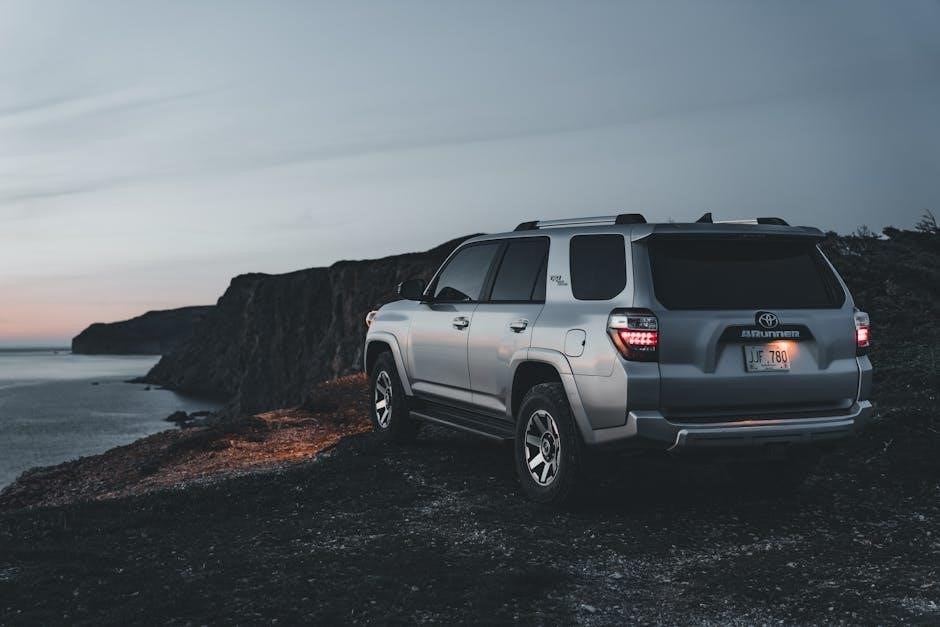
Exterior Features
Explore the Highlander’s exterior components, including lighting, mirrors, and wipers, to maximize visibility and ensure safe operation in all weather conditions.
Lights and Signals
Your 2012 Toyota Highlander is equipped with a comprehensive lighting system designed for optimal visibility and safety. This includes headlights, taillights, brake lights, turn signals, and hazard lights. Familiarize yourself with the operation of each light, as well as the headlight beam adjustment features.
The Highlander also features daytime running lights (DRL) for increased visibility during daylight hours. Understand how to activate and deactivate these lights as needed. Proper use of signals is crucial for communicating your intentions to other drivers. Regularly inspect all lights to ensure they are functioning correctly, replacing any burnt-out bulbs promptly.
Refer to the vehicle’s lighting control panel for specific switch locations and functions.
Mirrors
The 2012 Toyota Highlander features both exterior and interior mirrors designed to provide optimal visibility for safe driving. Exterior mirrors are power-adjustable, allowing you to customize their position for the best view of surrounding traffic. Understand how to use the adjustment controls located inside the vehicle.
The interior rearview mirror can also be adjusted, and some models include an auto-dimming feature to reduce glare from headlights behind you. Familiarize yourself with this function. Regularly clean all mirrors to ensure clear visibility.
Proper mirror adjustment is essential for minimizing blind spots and maximizing awareness of your surroundings while driving.
Wipers and Washers
Your 2012 Toyota Highlander is equipped with windshield wipers and washers to maintain clear visibility during inclement weather. The wiper speed can be adjusted to suit the intensity of rain or snow, using the controls located on the steering column. Understand the various speed settings and intermittent wipe function.
The washer fluid reservoir provides fluid to clean the windshield. Regularly check and refill the reservoir with appropriate windshield washer fluid. The rear window also has a wiper and washer system, operated separately.
Ensure wiper blades are in good condition, replacing them when they streak or fail to clear the windshield effectively.

Troubleshooting
This section offers guidance on resolving common issues, providing simple solutions and emergency procedures to help you address unexpected situations with your Highlander.
Common Issues and Solutions
Experiencing difficulty starting your 2012 Highlander? Check the battery connections and ensure sufficient fuel. A flashing check engine light often indicates a loose gas cap or minor emission control issue; tighten the cap and monitor.
If you notice unusual noises during braking, inspect the brake pads and rotors for wear. For issues with the audio system, verify the connections and check the fuse box.
Should the navigation system freeze, try a system reset as outlined in the ‘Audio System Operation’ section. Remember to consult a qualified technician for complex repairs or persistent problems not addressed by these simple solutions.
Emergency Procedures
In the event of a collision, prioritize safety: ensure passengers are secure and assess for injuries. Activate hazard lights immediately to alert other drivers. If smoke is present, evacuate the vehicle quickly and move to a safe distance.
For a flat tire, safely pull over, engage the parking brake, and follow the tire change instructions detailed in the ‘Tire Pressure and Maintenance’ section.
Should the vehicle overheat, pull over, turn off the engine, and allow it to cool before checking coolant levels. Familiarize yourself with the location of the first-aid kit and emergency contact information.

Specifications
This section details the 2012 Toyota Highlander’s key technical data, including engine size, dimensions, weight capacity, and fuel tank volume for reference.
Engine Specifications
The 2012 Toyota Highlander offered several engine options, catering to diverse driving needs and preferences. The standard engine was a 2.7-liter four-cylinder producing 187 horsepower and 186 lb-ft of torque, providing adequate power for everyday commuting.
For those seeking enhanced performance, a 3.5-liter V6 engine was available, generating 270 horsepower and 248 lb-ft of torque. This engine delivered a more responsive and dynamic driving experience. Both engines were paired with a six-speed automatic transmission.
Hybrid models featured a 3.5-liter V6 combined with an electric motor, resulting in a total system output of 306 horsepower. These models prioritized fuel efficiency without sacrificing performance. Understanding your Highlander’s specific engine is crucial for proper maintenance and optimal operation.
Dimensions and Weight
The 2012 Toyota Highlander boasts generous dimensions, providing ample space for passengers and cargo. Its overall length measures 190.9 inches, with a width of 75.8 inches and a height ranging from 66.8 to 67.8 inches depending on the model.
Wheelbase is 109.8 inches, contributing to a stable and comfortable ride. Curb weight varies based on engine and drivetrain configuration, ranging from approximately 3,790 lbs for the base four-cylinder model to around 4,220 lbs for the V6 versions.
Hybrid models typically weigh between 4,300 and 4,400 lbs. Knowing these dimensions and weight figures is helpful for parking, maneuvering, and understanding vehicle capacity.
Fuel Capacity
The 2012 Toyota Highlander is equipped with a fuel tank capacity of 19.2 gallons. This substantial capacity allows for extended driving ranges between refueling stops, enhancing convenience for long journeys. The Highlander’s fuel grade requirement is unleaded regular gasoline with an octane rating of 87 or higher.
Always refer to the fuel filler door for specific recommendations. Utilizing the correct fuel type is crucial for optimal engine performance and longevity.
Regularly monitoring your fuel levels and planning refueling stops accordingly will ensure a smooth and uninterrupted driving experience. Remember to consult your local Toyota dealer for any fuel-related questions.