Altistart 22 Manual: A Comprehensive Guide
This comprehensive guide details the Altistart 22 soft starter, referencing documentation available from Schneider Electric, including user manuals (like BBV51330) downloadable online.
The Altistart 22 is a versatile soft starter designed for controlling asynchronous motors, offering a cost-effective solution for reducing mechanical and electrical stress during motor starts and stops; As detailed in resources like the ATS22 User Manual (S1A14738), available on the Schneider Electric website, this device provides controlled voltage reduction during starting, minimizing inrush current and torque peaks.
It’s suitable for a wide range of applications, from pumps and fans to conveyors and compressors. The Altistart 22 facilitates smoother operation, extending equipment lifespan and reducing energy consumption. Understanding its functionalities, as outlined in documentation BBV51330, is crucial for optimal performance and safe operation. Proper setup, following the Quick Start guide, ensures reliable motor control.
What is a Soft Starter and Why Use One?
A soft starter, like the Altistart 22, is an electrical device used to gradually increase the voltage applied to an electric motor during startup, and decrease it during shutdown. This contrasts with direct-on-line starting, which applies full voltage immediately. Utilizing a soft starter minimizes mechanical shock to the driven equipment, reducing stress on couplings, gearboxes, and belts.
Furthermore, it significantly lowers inrush current, decreasing demand charges and improving power factor. As highlighted in the ATS22 documentation, this technology extends motor life and reduces maintenance costs. The Altistart 22 offers a cost-effective alternative to more complex variable frequency drives (VFDs) for applications where precise speed control isn’t required, providing smooth and controlled motor acceleration and deceleration.

Understanding the Altistart 22 Components
The Altistart 22 comprises control and power terminals, a display panel, and internal circuitry, all detailed in the user manual (S1A14738).
Control Terminals and Their Functions
The Altistart 22’s control terminals facilitate external control and monitoring of the soft starter’s operation. These terminals, thoroughly documented in the user manual (S1A14738 and BBV51330), enable functionalities like start/stop control, emergency stop activation, and fault signal indication. Key terminals include those for command functions, allowing remote operation, and terminals dedicated to monitoring the starter’s status.
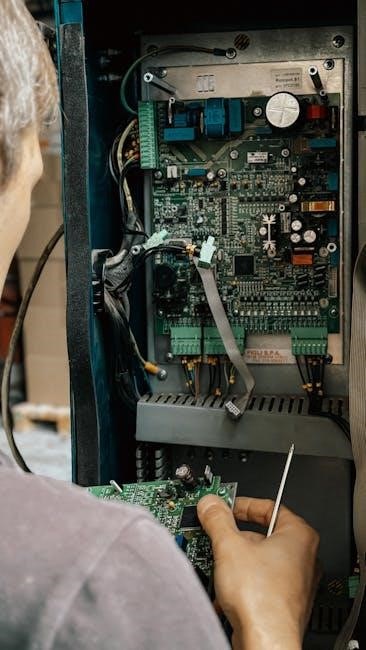
Specific functions are assigned to each terminal, enabling integration with Programmable Logic Controllers (PLCs) or other automation systems. The manual details the precise wiring configurations for these terminals, ensuring correct operation and preventing damage. Understanding these functions is crucial for proper system integration and troubleshooting, as outlined in the provided documentation from Schneider Electric.
Power Terminals and Wiring
The Altistart 22’s power terminals are designed for connecting the main power supply and the motor leads, as detailed in the user manual (S1A14738 & BBV51330). Correct wiring is paramount for safe and reliable operation. The manual provides clear diagrams illustrating the appropriate connections for various voltage configurations (230/440V, 50/60Hz).
Proper cable sizing and termination are critical, considering the motor’s full load amps (FLA) and any necessary derating factors based on ambient temperature (e.g., 10% derating at 50°C/122°F, as shown in examples for ATS22D32Q). The documentation emphasizes adherence to electrical safety guidelines during installation. Incorrect wiring can lead to equipment damage or pose a safety hazard, so careful attention to the manual’s instructions is essential.
Display Panel and Indicators
The Altistart 22 features a display panel providing crucial operational information and status indications, as outlined in the user manual (S1A14738 & BBV51330). This panel typically shows parameters, fault codes, and the current operating mode; LED indicators signal the unit’s status – ready, running, fault, and more – aiding in quick diagnostics.
Understanding these indicators is vital for troubleshooting. The manual details the meaning of each LED combination, allowing technicians to quickly identify potential issues; The display facilitates parameter adjustments and monitoring of key variables. Proper interpretation of the display and indicators, as described in the documentation, ensures efficient operation and minimizes downtime. Referencing the manual is key to understanding the specific signals.
Installation and Commissioning
Proper installation and commissioning, detailed in the Altistart 22 manual (BBV51330), involve inspection, mounting, wiring, and initial configuration steps before power-up.
Receiving and Inspecting the Unit
Upon receiving the Altistart 22, a thorough inspection is crucial, as outlined in the user manual (S1A14738 & BBV51330). Verify the unit hasn’t sustained damage during transit. Carefully check for any visible signs of physical harm to the enclosure, terminals, or display panel.
Confirm the received model number aligns with your order specifications. Compare the device’s rating label with your system requirements, ensuring correct voltage and current capabilities. Document any discrepancies or damage immediately, contacting both the carrier and Schneider Electric. Retain all packaging materials for potential inspection or return purposes. A detailed inspection prevents issues during commissioning and ensures safe, reliable operation.
Mounting the Altistart 22
Proper mounting of the Altistart 22 is essential for optimal performance and longevity. The user manual details specific mounting guidelines, prioritizing adequate ventilation to prevent overheating. Ensure the mounting surface is clean, flat, and capable of supporting the unit’s weight.
Maintain sufficient clearance around the soft starter for easy access during maintenance and wiring. Avoid mounting near sources of excessive heat, dust, or moisture. Securely fasten the unit using appropriate hardware, adhering to recommended torque specifications. Vertical mounting orientations are generally preferred, but consult the manual for specific model restrictions. Correct mounting minimizes vibration and ensures reliable operation within specified environmental conditions.
Wiring Diagram Overview
The Altistart 22 wiring diagram, detailed in the user manual (S1A14738), illustrates the connections for power, control, and motor terminals. It’s crucial to follow this diagram precisely for safe and correct operation. Power terminals accommodate the incoming line supply and output to the motor, while control terminals manage start/stop signals and other functions.
Pay close attention to the specified wire gauges and torque requirements for each connection. Proper grounding is paramount for electrical safety. The diagram clarifies the connections for optional features like remote control or communication interfaces. Always disconnect power before making any wiring changes, and verify all connections before energizing the system. Incorrect wiring can lead to equipment damage or personal injury.
Initial Power-Up and Configuration

Upon initial power-up, the Altistart 22 performs a self-test, indicated by the display panel. Refer to the user manual (BBV51330) for interpreting LED diagnostics during this phase. Before starting, verify the motor nominal current (In) parameter is correctly set – a critical step for optimal performance and protection.
Initial configuration involves accessing the parameter menu, typically through the control terminals or display panel. The Quick Start guide, accompanying the unit, provides step-by-step instructions. Ensure the soft starter is configured to match the motor’s specifications and application requirements. Incorrect settings can lead to inefficient operation or potential damage. Document all parameter changes for future reference.

Parameter Settings and Programming
Accessing the parameter menu allows customization of the Altistart 22, including motor current (In) settings, ramp times, and current limits, as detailed in the manual.
Accessing the Parameter Menu
Navigating the Altistart 22’s parameter menu is crucial for tailoring its operation to specific motor and application requirements. Typically, access is achieved through the integrated display panel and associated navigation buttons. The user manual (like S1A14738 referenced online) provides a detailed walkthrough of this process, outlining the button sequences needed to enter programming mode.
Within the menu, parameters are often organized logically by function – starting, stopping, protection, and communication. Understanding this structure, as explained in the documentation, simplifies locating and modifying desired settings. The manual emphasizes the importance of documenting any parameter changes for future reference and troubleshooting. Careful attention to the manual’s instructions ensures correct parameter access and modification, preventing unintended operational changes.
Motor Nominal Current (In) Setting
Accurately setting the motor nominal current (In), also known as Motor FLA, is paramount for the Altistart 22’s proper function and protection. This parameter informs the soft starter about the motor’s full-load amperage, enabling correct current limiting and overload protection. The user manual (BBV51330) details how to find this value on the motor’s nameplate.
Crucially, derating factors must be considered, especially at higher ambient temperatures or altitudes. For example, at 50°C (122°F), the manual illustrates a potential 10% derating for a 32A motor, reducing the In setting to 24A. Incorrect In settings can lead to nuisance trips or, more seriously, inadequate motor protection. Always consult the manual and apply appropriate derating factors for the operating environment.
Starting and Stopping Parameters
The Altistart 22 offers extensive control over motor starting and stopping profiles, configurable through its parameter menu. Key parameters include starting ramp time, which dictates the acceleration duration, and stopping ramp time, controlling deceleration. Adjusting these parameters minimizes mechanical stress on the driven equipment and reduces electrical network disturbances.
The user manual (S1A14738 & BBV51330) details various starting modes, such as current limiting and voltage ramp, each suited for different applications. Similarly, stopping modes can be adjusted for controlled deceleration or a quicker, free-wheel stop. Proper configuration, guided by the manual’s quick start guide, ensures smooth and efficient operation, optimizing both performance and longevity.
Ramp Time Adjustment
Adjusting ramp times is crucial for optimizing Altistart 22 performance and protecting connected equipment. The starting ramp time, configurable via parameters, determines the acceleration duration, influencing motor torque and current draw. Similarly, the stopping ramp time controls deceleration, preventing water hammer in pump applications or abrupt stops in conveyor systems.
The user manual (BBV51330) emphasizes careful consideration of mechanical load characteristics when setting these times. Shorter ramp times offer faster acceleration/deceleration but can induce stress; longer times reduce stress but extend cycle durations. Derating factors, like ambient temperature (e.g., 50°C/122°F), may necessitate adjustments, as noted in application examples, to maintain safe operation and prevent exceeding current limits.
Current Limit Settings
Proper current limit configuration within the Altistart 22 is vital for protecting both the motor and the soft starter itself. These settings, adjustable through dedicated parameters, restrict the maximum current drawn during starting and running, preventing overloads and potential damage. The manual (BBV51330) details how to set these limits based on the motor’s nominal current (In or FLA).
Derating factors, such as operating temperature and altitude, significantly impact allowable current. For instance, at higher temperatures (e.g., 50°C), the maximum current may need reduction, as illustrated by examples showing current derating (e.g., 32A becoming 24A). Exceeding these limits can trigger fault codes and halt operation, emphasizing the importance of accurate setting and monitoring.
Advanced Features and Functions
The Altistart 22 offers torque control, PID integration, and communication via Modbus protocol, expanding its capabilities beyond basic soft starting and stopping.
Torque Control
Altistart 22’s torque control feature allows for precise management of motor torque during starting and stopping, crucial for applications demanding controlled acceleration or deceleration. This functionality minimizes mechanical stress on driven equipment, reducing wear and tear and enhancing overall system reliability.
By carefully regulating torque, the Altistart 22 can prevent sudden jolts or overloads, particularly beneficial for handling sensitive materials or maintaining consistent process conditions. Users can adjust torque parameters to optimize performance based on the specific application requirements, ensuring smooth and efficient operation. This control extends beyond starting; it’s also valuable during controlled stops, preventing water hammer in pumps or maintaining tension in winding applications.
Proper torque control setup requires understanding the motor’s characteristics and the load demands, allowing for fine-tuning of parameters for optimal results.
PID Control Integration
The Altistart 22 facilitates integration with Proportional-Integral-Derivative (PID) control systems, enabling sophisticated process control applications. This integration allows the soft starter to respond dynamically to process variables, maintaining desired setpoints with precision. By receiving feedback from sensors, the Altistart 22 adjusts motor speed or torque to compensate for disturbances and ensure stable operation.
This capability is particularly valuable in applications like pump and fan control, where maintaining consistent flow rates or pressures is critical. PID control optimizes energy efficiency by adjusting motor output to match actual demand, reducing wasted energy. Implementing PID control requires configuring the Altistart 22 to accept external control signals and properly tuning the PID parameters for optimal performance and stability.
Careful setup ensures responsive and accurate process regulation.
Communication Protocols (Modbus)
The Altistart 22 supports the Modbus communication protocol, enabling seamless integration into larger automation systems. This allows for remote monitoring, control, and diagnostics of the soft starter via a Modbus network. Parameters can be read and written remotely, facilitating centralized management and data logging.
Modbus communication utilizes a master-slave architecture, where the Altistart 22 functions as a slave device responding to requests from a Modbus master, such as a PLC or SCADA system. Configuration involves setting the Modbus address, baud rate, and parity settings to ensure proper communication. Accessing registers allows for real-time monitoring of motor current, voltage, and power consumption.
Troubleshooting network issues and verifying correct parameter settings are crucial for reliable operation.
Troubleshooting and Diagnostics
Effective troubleshooting relies on understanding fault codes and LED indicators, allowing for quick identification of issues within the Altistart 22 soft starter.
Common Fault Codes and Their Meanings
Understanding fault codes is crucial for efficient Altistart 22 troubleshooting. These codes, displayed on the unit or through connected systems, pinpoint specific issues. For example, an “Overload” fault indicates excessive motor current, potentially due to mechanical issues or incorrect parameter settings.
A “Phase Loss” fault signals a missing phase in the power supply, demanding immediate investigation of wiring and power source. “Overvoltage” or “Undervoltage” faults point to power supply problems requiring electrician intervention. The manual (like S1A14738) provides a detailed list of these codes.
Diagnostic procedures often involve checking related parameters and wiring connections. Regularly consulting the manual’s fault code table ensures accurate interpretation and swift resolution of operational problems, minimizing downtime and maximizing system reliability.
LED Indicator Diagnostics
The Altistart 22 utilizes LED indicators to provide quick status assessments. A solid green LED typically signifies normal operation, while a flashing green light often indicates the unit is ready but not running. Red LEDs signal faults, and the specific flashing pattern reveals the nature of the problem – referencing the user manual (like BBV51330) is essential.
For instance, a rapidly flashing red LED might denote an overload condition, while a slower flash could indicate a phase loss. Observing the LED sequence before consulting the manual can expedite initial diagnosis.
These visual cues offer a preliminary diagnostic step, helping technicians quickly identify potential issues without needing specialized tools. Understanding these indicators minimizes troubleshooting time and ensures efficient maintenance of the soft starter.
Resetting the Altistart 22
Resetting the Altistart 22 typically involves clearing a fault condition and restoring the unit to operational status. Following a fault, the first step is to address the root cause – identified through LED diagnostics and fault code interpretation (referencing documentation like S1A14738).
Once the issue is resolved, a manual reset is often required. This can usually be achieved by cycling the power supply to the unit, or through a dedicated reset parameter accessible via the display panel.
Important Note: Simply clearing the fault doesn’t fix the underlying problem. Repeated resets without addressing the cause can lead to further damage. Always consult the user manual for specific reset procedures and safety guidelines.

Technical Specifications
Altistart 22 specifications include voltage/current ratings, operating temperature ranges, and derating factors (temperature & altitude), as detailed in manuals like BBV51330.
Voltage and Current Ratings
The Altistart 22 boasts a versatile range of voltage and current ratings, accommodating diverse motor applications. Commonly available models support 230/440V, 50/60Hz power supplies, ensuring compatibility across various global standards. Current ratings vary significantly based on the specific Altistart 22 model; for instance, units like ATS22D32Q are designed for up to 32 Amps.
However, it’s crucial to consider derating factors. As highlighted in documentation (BBV51330), at elevated temperatures – such as 50°C (122°F) – the maximum nominal motor current may be reduced. For a 32A unit, this could be derated to 24A, maintaining operational safety and longevity. Always consult the specific model’s datasheet for precise ratings and applicable derating curves.
Operating Temperature Range
The Altistart 22 is engineered to function reliably within a specified temperature range, typically between -10°C and 40°C (14°F to 104°F) for optimal performance. However, exceeding these limits necessitates derating the unit’s current capacity to prevent overheating and potential damage. As detailed in documentation like BBV51330, operating at higher ambient temperatures significantly impacts the maximum allowable motor current.
For example, at 50°C (122°F), a 32A rated Altistart 22 might be derated to 24A, reducing its capacity by 10%. It’s vital to consult the product datasheet for precise derating factors at different temperatures and altitudes. Proper ventilation and avoiding direct sunlight are also crucial for maintaining the unit within its specified operating range, ensuring long-term reliability.
Derating Factors (Temperature & Altitude)
Altistart 22 performance is affected by ambient temperature and altitude, requiring current derating to prevent overheating and ensure reliable operation. Higher temperatures and altitudes reduce the unit’s ability to dissipate heat effectively. Documentation, such as BBV51330, provides specific derating curves and factors.
For instance, an ATS22D32Q at 50°C (122°F) might experience a 10% current reduction, lowering the maximum nominal motor current from 32A to 24A. Altitude also plays a role; increased elevation reduces air density, hindering heat transfer. These factors are multiplicative, meaning both temperature and altitude derating must be applied. Always consult the manual for precise values and ensure the selected Altistart 22 is appropriately sized for the application’s environmental conditions.

Safety Precautions
Prioritize safety when installing and servicing the Altistart 22, adhering to electrical and mechanical guidelines, and always implementing emergency stop procedures.
Electrical Safety Guidelines
Before commencing any work with the Altistart 22, always disconnect and lock out the main power supply to prevent accidental energization. Qualified personnel should perform all electrical connections, ensuring compliance with local and national electrical codes. Verify proper grounding of the unit to minimize the risk of electric shock and equipment damage.
Inspect all wiring for insulation damage or loose connections before applying power. Utilize appropriately rated fuses or circuit breakers to protect the Altistart 22 and connected motor. Avoid working on live circuits; if unavoidable, use insulated tools and wear appropriate personal protective equipment (PPE), including safety glasses and insulated gloves. Regularly check for signs of overheating or electrical stress, and address any issues promptly.
Remember that improper electrical work can lead to severe injury or death, and can also damage the equipment.
Mechanical Safety Guidelines
Ensure the Altistart 22 is mounted securely to a suitable surface capable of supporting its weight and withstanding potential vibrations. Verify adequate ventilation around the unit to prevent overheating, maintaining recommended clearances as specified in the manual. Avoid installing the soft starter in areas exposed to excessive dust, moisture, or corrosive substances.
During installation and maintenance, use appropriate lifting equipment if the unit is heavy. Inspect the enclosure for any physical damage before and after installation. Secure all wiring connections to prevent strain on terminals. Regularly check mounting hardware for tightness and stability.
Always be aware of moving parts in the surrounding environment and take precautions to avoid accidental contact. Proper mechanical installation is crucial for safe and reliable operation.
Emergency Stop Procedures
In an emergency situation requiring immediate shutdown, disconnect the main power supply to the Altistart 22. This is the most effective method to halt operation quickly and safely. Ensure all personnel are aware of the location of the main disconnect switch.
Depending on the application, integrate an external emergency stop circuit wired to remove power from the Altistart 22’s control terminals. This provides a redundant safety measure. Verify the emergency stop circuit functions correctly through regular testing.
Following an emergency stop, investigate the cause before restoring power. Do not attempt to restart the system until the issue is resolved and it is safe to do so. Consult the manual for detailed troubleshooting guidance.